Teams lose hours every week hunting for files, threads, and notes scattered across a dozen apps. A pricing sheet sits in Google Drive. A policy lives in Notion. The decision that explains everything is buried in a Slack thread. Zecway aims to fix that problem. This Bangalore-based company builds an AI-powered workplace search and knowledge platform, and it also runs a creative agency.
This guide explains what Zecway does, how the software works, and who it fits best. You will see how its permission model protects sensitive files, how it compares with Glean, Elastic, and You Technologies, and what its sister agency offers. By the end, you will know whether the platform deserves a place on your shortlist and how to test it fairly before you commit.
What Is Zecway and Who Founded It
Zecway is an emerging technology brand headquartered in Bangalore, Karnataka, India. Anurag Gautam Sharma and Rajat Kumar founded it. The flagship product is an AI-powered workplace search and knowledge platform. It acts as an intelligence layer on top of the tools your team already uses, so people can ask one question and get one useful answer instead of opening five tabs.
The brand has two sides. The enterprise software side serves companies that want faster access to internal knowledge. The creative side handles marketing and branding for clients. This article focuses mainly on the software, then covers the agency. Details here come from the company’s public positioning, so confirm current features and pricing directly before you buy.
How the AI Workplace Search Platform Works
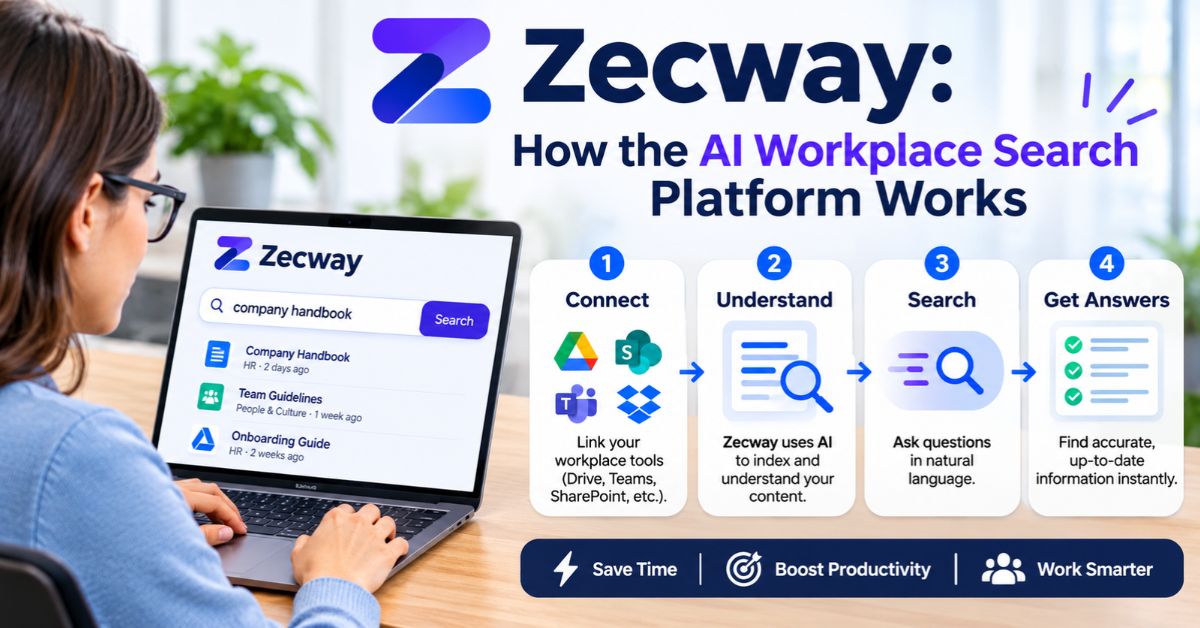
The platform connects to workplace apps such as Google Drive, Slack, Notion, and email. It then crawls those sources and builds one searchable layer. Employees type a question into a single search bar. According to the company, results arrive in under 0.4 seconds. That speed matters because slow search pushes people back to asking coworkers, which interrupts everyone’s day and breaks focus.
Beyond search, the platform includes an AI assistant that writes grounded answers, summaries, and action items. It adapts to your company voice. Every fact links back to a source document, so you can verify claims in seconds. That citation habit builds trust, because nobody has to wonder whether the AI invented something. You simply click through and check the original file.
| Feature | What it does | Why it helps |
|---|---|---|
| Instant workplace search | Searches connected apps from one bar | Less tab hopping |
| Contextual AI assistant | Writes cited answers and summaries | Easier fact-checking |
| Autonomous agents | Runs scheduled research or background tasks after human approval | Less repetitive work |
| Database-level permissions | Applies access rules before AI processing | Protects sensitive files |
A typical search follows these steps:
- Your admin connects Google Drive, Slack, Notion, and email.
- An employee types a plain-language question.
- The platform searches only content that person may access.
- The AI returns a cited answer, summary, or action list.
- The employee clicks a citation to confirm the source.
Permissions and Security: What to Check
Security is the first worry with any AI search tool. The platform addresses it with database-level permissions. It enforces access rules before any AI processing begins. So users only get answers drawn from documents they already have clearance to view. Someone in sales will not see answers drawn from confidential HR files, even when they ask directly. That design sharply reduces the risk of accidental data leaks.
Still, no vendor claim replaces your own review. Before rollout, ask about data storage, encryption, certifications, and audit logs. Test permissions with real accounts from different departments. A short security checklist keeps the evaluation honest and gives your IT lead clear evidence to approve or reject the tool.
Who the Platform Is Built For
The product targets teams of 30 to 500 employees. That range makes sense. Smaller teams can often find files by asking a colleague. Giant enterprises usually need heavy customization and long rollouts. Mid-size companies sit in the middle, where knowledge is scattered, onboarding is constant, and nobody has time to dig through old folders for a pricing sheet or policy. That is the gap it wants to fill.
Picture a 120-person software company. A new support hire asks how to handle a refund dispute. Instead of pinging three managers, she searches Zecway and gets a cited answer pulled from a Notion policy and a Slack thread. This scenario is hypothetical, but it shows the everyday time savings the company promises. Roles that are likely to benefit most include:
- Customer support agents
- Sales and account teams
- HR and operations staff
- New hires during onboarding
Zecway vs Glean, Elastic, and You Technologies
Zecway competes in the enterprise software space with Glean, Elastic, and You Technologies. Those names have larger footprints. Its angle is focus. It targets mid-size teams rather than massive enterprises, and it emphasizes cited answers and permission-first design. Whether that edge matters depends on your size, budget, and tolerance for working with a younger vendor. Compare them on facts, not on brand names.
| Factor | Platform (per company) | What to verify |
|---|---|---|
| Target size | 30–500 employees | Does your headcount fit? |
| Connected apps | Google Drive, Slack, Notion, email | Are your other tools supported? |
| Answer style | Grounded, cited answers | Citation accuracy in testing |
| Permissions | Database-level, before AI processing | Admin and audit controls |
| Speed | Under 0.4 seconds claimed | Real speed on your data |
| Automation | Agents run after human approval | Approval workflow details |
Run a side-by-side pilot. Give each tool the same ten real questions your team asks every week, then score accuracy, speed, citation quality, and permission handling. A two-week trial reveals more than any demo. Also compare onboarding effort, since a tool that needs weeks of setup erodes the time it promises to save. Pricing also deserves a direct quote.
The Creative Agency Behind the Brand
Zecway Studio is the company’s creative arm. It registered as a limited liability partnership in mid-2024 and works as a full-stack marketing and branding agency. Clients get one team for strategy and execution, which cuts coordination overhead. This agency operates separately from the AI search product, so the two serve different buyers with different needs. Keep that split in mind while researching.
The studio offers digital marketing, brand identity, social media growth, ad optimization, SEO, and UI/UX design. It frequently serves niche sectors, including interior designers, architects, and consumer grooming salons. These visual, local-first businesses rely on strong branding and steady social presence, which fits the studio’s mix of design and performance marketing skills. Ask for case studies and measurable results before hiring any agency.
Is This Platform Right for Your Team
Start with your pain. If employees spend hours each week searching Slack, Drive, and Notion, a unified search layer could pay off quickly. If your files live in one tool, native search may be enough. Be honest about your setup, because the best software cannot fix poor documentation habits or a team that never writes anything down. Fix that first.
A clear evaluation process saves money and avoids regret. Before you sign anything, measure how much time your team loses to searching today, then set a target. Without a baseline, you cannot prove the tool worked. Keep the pilot small, time-boxed, and tied to real work. Involve both IT and daily users. Follow these steps to run a fair trial:
- Track weekly search time for two weeks.
- Request a demo using your own apps.
- Test permissions with different user roles.
- Ask for pricing, security documents, and support terms.
- Compare results against your baseline and one rival.
Conclusion
Zecway tackles a real problem: valuable knowledge buried across too many apps. Its AI workplace search platform pulls Google Drive, Slack, Notion, and email into one fast, cited, permission-aware search bar. It is built for teams of 30 to 500 employees who want to recover time lost to manual digging. Database-level permissions and traceable citations give it a trust-first design that many buyers will value.
Still, claims on a website are not proof. Before committing, test the product on your own data, verify security details, and compare it with at least one rival. Zecway Studio, the sister agency, serves a different audience, so evaluate it separately. If a two-week pilot shows real time savings, Zecway could earn a permanent spot in your team’s toolkit.