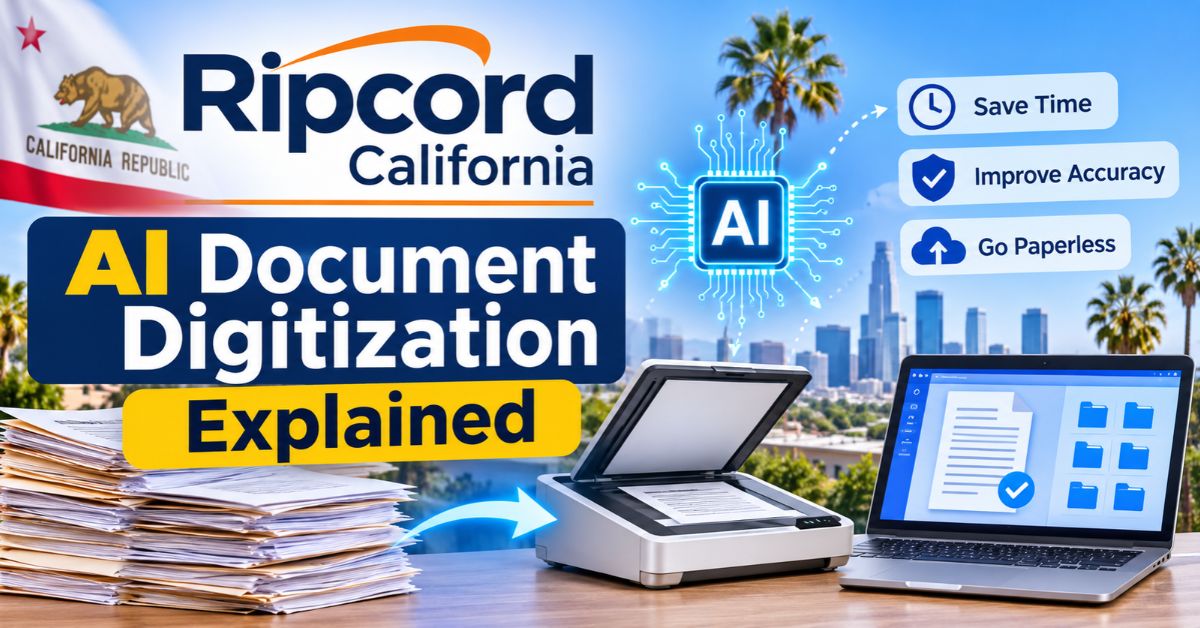
Paper still piles up in warehouses, basements, and records rooms across America. Ripcord California is one answer to that problem. The Hayward-based company uses robots, sensors, machine learning, and generative AI to turn paper and unstructured files into searchable digital data. Instead of storing boxes no one can search, organizations can turn them into data they can actually use.
This guide explains what Ripcord does, how its technology works, and where its facilities operate. You will also learn who founded the company, which investors back it, and which organizations trust it with their records. Along the way, you will see how robotic digitization compares with traditional scanning, so you can judge whether it fits your own project.
What Is Ripcord and Where Is It Based?
Ripcord is an AI-powered robotic digitization and document intelligence company. Founded in 2015 out of NASA research, it blends advanced sensors, vision-guided robotics, machine learning, and generative AI. The goal is simple. Take paper and messy, unstructured files, then extract and classify what is inside. The result is searchable, digital data that fits modern workflows instead of sitting in a box.
Ripcord California describes the company’s home base. Its headquarters sits at 30955 Huntwood Ave, Hayward, CA 94544, in the San Francisco Bay Area. In May 2026, the company added a flagship facility in Union City. Both sites keep Ripcord in the heart of the Bay Area tech scene, close to the robotics, software, and venture communities that shaped it.
| Detail | Ripcord at a Glance |
|---|---|
| Founded | 2015 |
| Origin | NASA research |
| Headquarters | 30955 Huntwood Ave, Hayward, CA 94544 |
| Flagship facility | Union City, CA (launched May 2026) |
| Funding raised | Over $151 million |
| Core technology | Sensors, vision-guided robotics, machine learning, generative AI |
How Ripcord’s Robotic Digitization Works
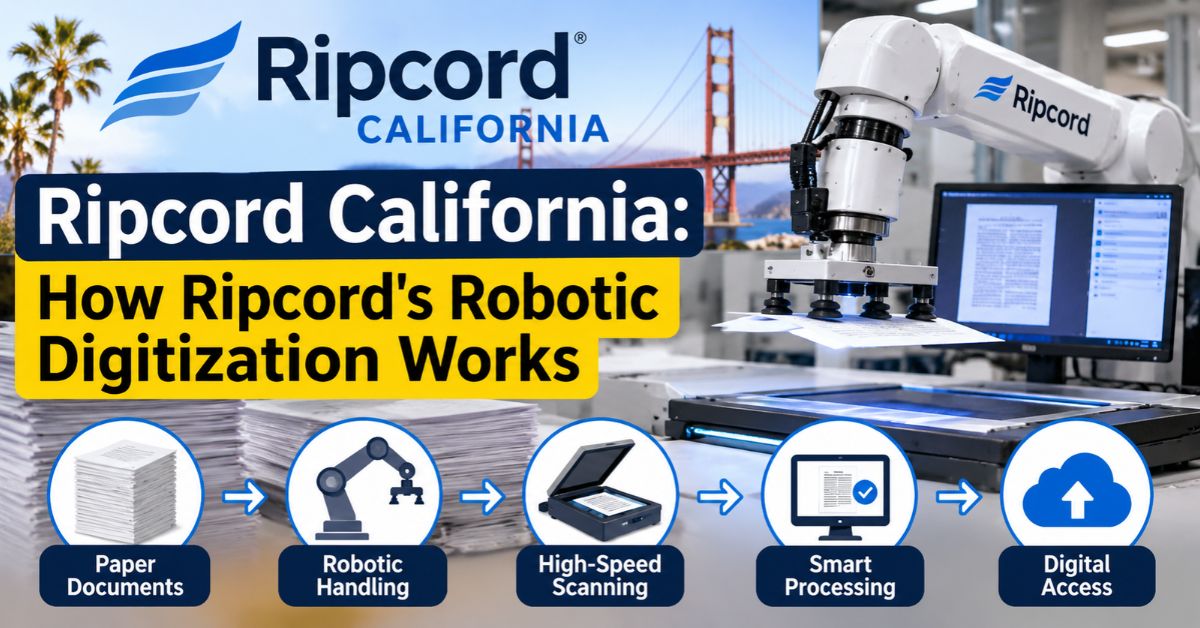
Traditional scanning relies on people to prep, feed, and index pages. Ripcord California changes that workflow. Vision-guided robots handle the physical documents, while sensors capture each page. Machine learning then reads the images and sorts them by type. Generative AI helps pull out key details. Together, these tools reduce manual handling and move records from paper to usable data with far less human effort.
The real value lies in what happens after the scan. A picture of a page is not much use if no one can search it. Ripcord extracts text and data, classifies each document, and prepares it for searchable workflows. That matters for teams that must find a contract, invoice, or case file in seconds instead of digging through filing cabinets for hours.
In broad terms, a robotic digitization workflow follows these steps:
- Intake: Paper records arrive and are logged.
- Robotic handling: Vision-guided robots move and position each document.
- Capture: Sensors create high-quality images of every page.
- Extraction: Machine learning reads text and pulls out key data.
- Classification: Software labels each document by type.
- Delivery: Clean, searchable data flows into the customer’s systems.
What Is Document Intelligence?
Document intelligence means using AI to read, understand, and organize documents the way a skilled clerk would, only far faster. It goes beyond basic scanning or simple text recognition. The software identifies what a document is, finds the fields that matter, and turns them into structured data. Businesses can then search, analyze, and automate with information that once lived only on paper.
Inside the Union City Data Fab
In May 2026, Ripcord California launched a new flagship facility in Union City. The 25,000-square-foot site is called a data fab. The name borrows from semiconductor fabrication plants, and it fits. The building is engineered to process up to 500 million pages of documents each year, turning large paper archives into structured data at industrial scale. That is serious volume.
The facility also targets NARA compliance. NARA stands for the National Archives and Records Administration, the federal agency that sets records management expectations. That focus matters for government agencies and regulated enterprises. It also supports a growing need. Companies want clean, well-organized data to train AI systems, and much of that knowledge still lives on paper. Digitization feeds that pipeline.
| Union City Data Fab | Details |
|---|---|
| Launch date | May 2026 |
| Size | 25,000 square feet |
| Annual capacity | Up to 500 million pages |
| Compliance focus | NARA |
| Target users | Enterprise and government digitization, AI training data |
Founders, Funding, and Customers

Alex Fielding, Kevin Hall, and Kim Lembo founded Ripcord. The company is venture-backed and has raised over $151 million. Investors include Google Ventures, Kleiner Perkins, Lux Capital, and Icon Ventures. Apple co-founder Steve Wozniak is also among its backers. That roster signals strong investor confidence in robotics-driven document intelligence, though funding alone does not prove results on any single project.
Customers offer a better test. Ripcord California provides data extraction and automation services to major global brands and institutions. These organizations span education, beverages, energy, government, and finance. Each manages huge volumes of records, and each faces pressure to keep them accurate, accessible, and secure. Named customers include:
- UCLA (higher education)
- Coca-Cola Bottlers (consumer goods)
- BP (energy)
- The IRS (government)
- MUFG Bank (financial services)
Ripcord vs. Traditional Document Scanning
Many buyers compare robotic digitization with a standard scanning bureau. Both convert paper to digital files. The difference lies in depth. A basic scanner produces images, often with light indexing added by hand. An AI-driven approach like Ripcord’s aims to deliver classified, searchable data that plugs straight into business systems and analytics tools. That gap affects cost, speed, and long-term usefulness.
| Feature | Traditional Scanning | AI-Driven Robotic Digitization |
|---|---|---|
| Document handling | Mostly manual | Vision-guided robotics |
| Output | Images or PDFs | Searchable, structured data |
| Indexing | Manual or basic | Machine learning classification |
| Scale | Varies by staff | Built for very large volumes |
| AI readiness | Low | High |
Not every project needs advanced digitization. A small box of files may need only a desktop scanner. Larger projects are different. If you manage millions of pages, face compliance rules, or want data ready for AI, a robotics-based provider like Ripcord California deserves a look.
Conclusion
Ripcord California stands out because it pairs robotics with AI to solve an old problem: paper that no one can search. Founded in 2015 out of NASA research, the Hayward company now backs its technology with over $151 million in funding. Its new Union City data fab is built to process up to 500 million pages a year and targets NARA compliance.
Its customer list, from UCLA and BP to the IRS and MUFG Bank, shows where this technology is headed. If your organization sits on large paper archives and wants searchable data ready for analytics or AI, Ripcord is worth a close look. Compare it with traditional scanning, ask about security and accuracy, and choose the approach that fits your records.