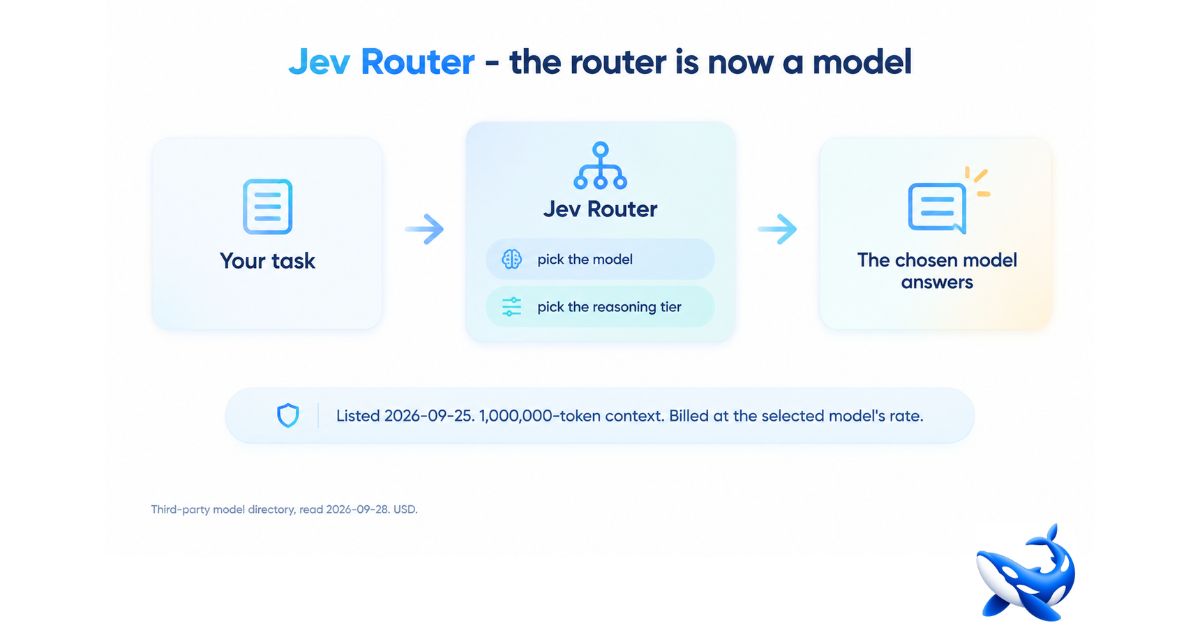
Routing is normally infrastructure. You pick a model, a gateway sends the request to it, and the interesting decision happened in your code before the request left. On 25 September 2026 a third-party model directory added an entry where that decision is the product: a routing model you call like any other, which picks the model and the reasoning tier on your behalf. It sits in a catalogue of new AI models where every other row is a model that answers questions, and this one answers a different question first. On OrcaRouter we already host the Jev 1.13 model — the structured decision model — while the routing entry itself is not carried as its own row, so it is worth being precise about what this entry does and does not change.
What the entry actually is
The listed specification is short. A context window of 1,000,000 tokens. A price field that does not contain a number, because the model does not have one rate — it bills at the rate of whatever model it selects. And a category that is not “chat”.
That last part matters more than it sounds. A conventional router is a policy: weights, rules, a classifier, a latency budget. You can read it, test it, and pin it. A routing model is a model: its output is a selection, produced by inference, and the selection can change between calls with identical inputs if the sampling parameters allow it. You have traded a policy you control for a prediction you observe.
The trade is not automatically bad. A learned router can read the request itself — the phrasing, the length, the number of tool definitions, whether there is an image — and that is information a rule written last quarter does not have. The cost is that you now have a second model in the critical path, and its latency is added to the latency of the model it chose.
The price field is the interesting part
A per-token price is a multiplier on a quantity you control. A router has no such price, and that absence is the whole story: the router’s cost is whatever the routed model costs, so the router’s *value* has to come from choosing better than you would have.
Put a number on that. Suppose your traffic is a mix where 60% of requests are answerable by a cheap model at $0.10 output and 40% need a frontier model at $10 output. If you route everything to the frontier model, your blended output rate is $10. If you route perfectly, it is $4.06. The entire budget a routing model has to justify is the gap between your current routing quality and perfect routing — and if your current routing is already a decent set of rules, that gap is much smaller than the headline suggests.
The second thing the price field hides is that routing decisions are made before the expensive call, so a wrong decision is paid for at the expensive model’s rate. A router that under-selects costs you quality you may not notice; one that over-selects costs you money you will notice. Those two errors are not symmetric, and no published number tells you which way a given routing model leans.
What we can and cannot verify about the vendor
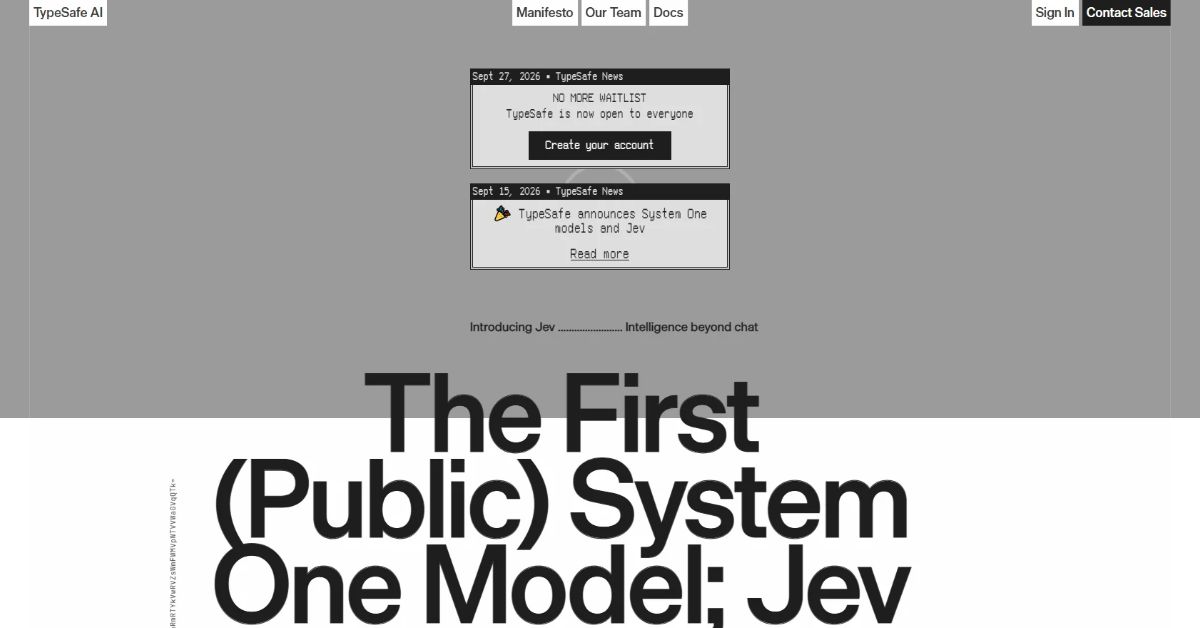
Jev’s vendor site is on `typesafe.ai`, and it behaves like a normal multi-page site rather than a placeholder. We checked five URLs on 28 September 2026 and got three distinct answers: the root and its `www` form each returned the same 579,893-byte landing page, `/blog` returned a separate 81,566-byte index, and `/jev` and `/pricing` returned genuine 7,384-byte 404s. The landing page describes the company as an AI lab building infrastructure for software that makes decisions, and names Jev as its first “System One Model” in early access, with copy about typed decisions carrying calibrated probabilities. What it does not carry is a single measured figure: no latency, no accuracy number, no benchmark, and no page on a third-party index to borrow one from.
That asymmetry is worth stating plainly because it is the recurring pattern in this batch of releases: the marketing arrives faster than the measurements. A directory entry dated 25 September is a fact about the directory, and a landing page describing calibrated probabilities is a fact about the vendor’s intentions. Neither is a fact about quality, and for this model there is no third-party index score to borrow, because no such page has been built.

How to test one without trusting it
Treat a routing model the way you would treat any new dependency whose failure mode is invisible: measure the decision, not the prose.
Take a frozen sample of real requests, at least a few hundred, and record for each one the model a human or your existing rules would have chosen. Then run the sample through the routing model and record its choices. You now have two label sets and can compute the agreement rate. Anything above roughly 85% on your own traffic means the router agrees with you often enough that its errors will be the rare case rather than the norm — and anything below that means you are paying a second inference to disagree with yourself.
Then do it a second time, a week later, with the same sample. A routing model whose choices have moved on frozen inputs is not broken, but it is not reproducible either, and reproducibility is the property that lets you reason about cost at all.
None of this requires the router to be good. It requires the router to be *stable*, which is a different and testable property.
The distinction that will get mangled in summaries
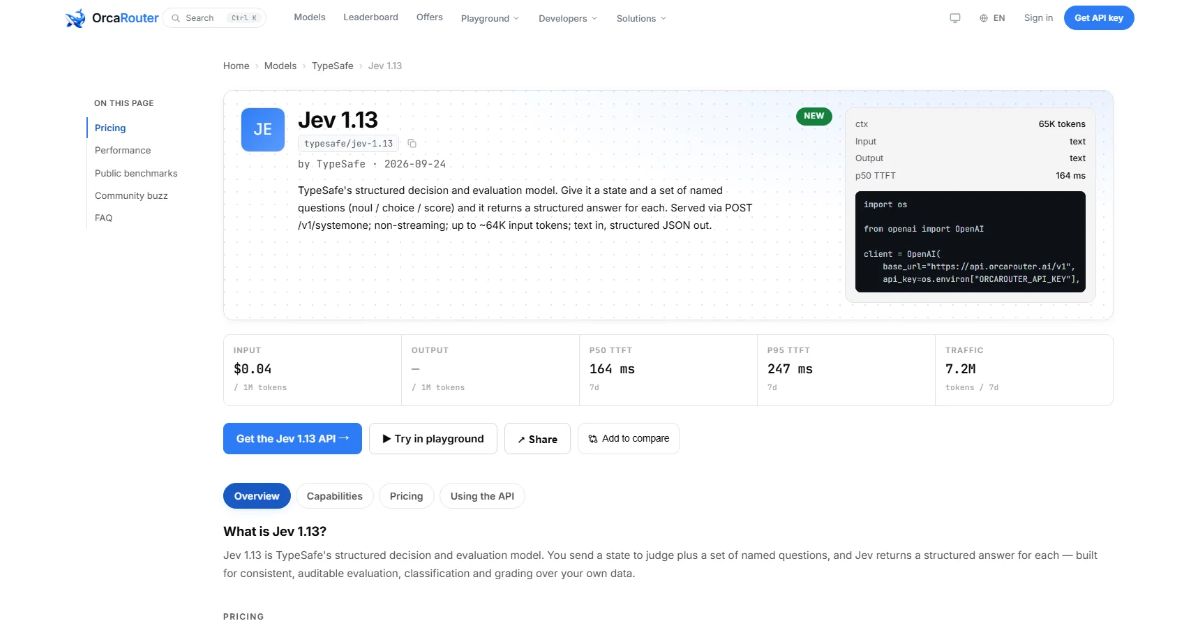
There are two Jev things, and they are not the same model. The routing entry listed on 25 September picks models and reasoning tiers. Separately, there is a structured decision model that answers named questions — true or false, a choice among options, or a score — through a dedicated endpoint, and whose responses are not streamed because they are short structured values rather than prose. The two share a vendor and a family name and nothing else.
This is the third time in this batch that a family name has been asked to cover two different products. It happened with the accelerated variants sold at separate prices, and it happened again with the reasoning modes sold at the same price as their base model. Reading a directory row and assuming it describes a chat model is the single most common way to be wrong about a September 2026 release, and a router entry is the extreme case: it is not merely a different model, it is a different layer.
What to do with it this week
If you already operate a gateway with routing rules, the useful action is not to swap them out. It is to run the frozen-sample test above and find out how often your rules and a learned router disagree, because that number is a budget: it is the maximum your routing could improve, and it is available before you change anything in production.
If you do not have routing rules yet, the ordering is the opposite of what the release calendar suggests. Write the rules first — even a crude two-tier split by prompt length captures most of the available saving — and only then consider replacing them, because a router is a refinement on top of a policy, not a substitute for having one.
Either way, the honest summary of 25 September 2026 is that a routing decision became a billable inference call. Whether that is progress depends entirely on whether your current decisions are worse than a model’s, and that is a question you can answer this week with data you already have.