Ciulioneros keeps showing up in blog posts and search suggestions, yet no dictionary lists it. If you searched for it, you want a straight answer. Here it is: the term has no official definition. This guide covers what we can verify, what remains guesswork, and how to judge the claims you read online. You will also get a simple checklist for vetting any unfamiliar word.
What Is Ciulioneros?
Ciulioneros is an uncommon internet term with no standardized definition. No major dictionary, encyclopedia, or linguistic authority defines it. The word has surfaced on scattered blogs and digital platforms in recent times, usually without a cited source. Because of that, treat any single definition as an opinion, not a fact. The honest summary is simple: its meaning depends on who is using it, and where they first saw it.
People search for ciulioneros for different reasons. Some spotted it in a social post and felt curious. Others found it in a blog article and wanted to confirm what it meant. A few may be checking a possible name, handle, or brand. All of them face the same problem: reliable sources are scarce, so results contain more speculation than evidence.
Where the Word Seems to Come From
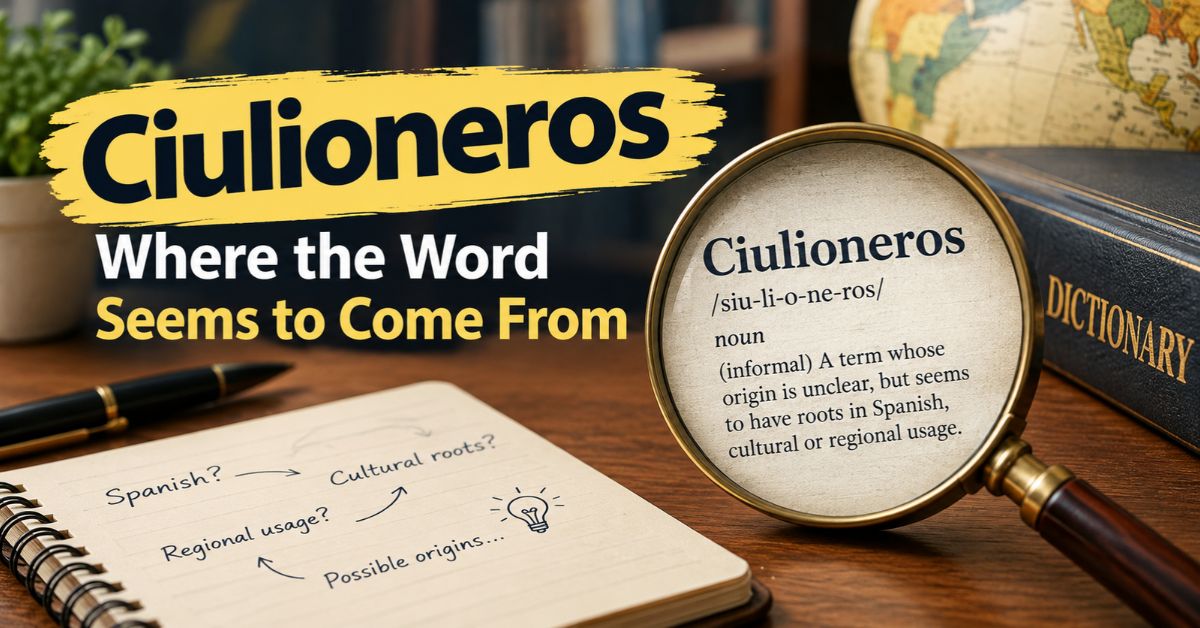
Structurally, the word looks Spanish. The “-eros” ending often marks a group tied to a trade, trait, or object, as in “panaderos” (bakers) or “zapateros” (shoemakers). That pattern makes the term feel familiar, even to readers who do not speak Spanish. But resemblance is not proof. A word can follow a grammar pattern without belonging to the language.
The internet has filled the gap with guesses. Different corners of the web describe the term as a youth culture movement, an artistic community, or humorous digital slang. Others treat it as a placeholder keyword used in SEO keyword experimentation, where writers publish pages on an invented term to see how search engines respond. None of these claims comes with primary evidence.
Is Ciulioneros a Spanish Word?
No. It mimics Spanish word formation, but it does not appear in standard Spanish references. Treat it as a niche internet term, not as vocabulary you can use in Spanish writing or speech.
Common Claims About Ciulioneros, Compared
Because no authority defines the word, each website tells its own story. Comparing those stories side by side shows how thin the evidence is. The table below sorts the most common claims by how well they can be supported today. Use it as a reading guide, not as a final verdict.
| Claim | Where it appears | Evidence level | How to treat it |
|---|---|---|---|
| Youth culture movement | Lifestyle-style blogs | Very low, no named members or events | Unverified |
| Artistic community | Culture and creative blogs | Very low, no named artists or works | Unverified |
| Humorous digital slang | Social posts and forums | Low, no consistent usage | Possible, but informal |
| SEO test keyword | Marketing discussions | Moderate, fits how the term spreads | Plausible explanation |
Notice the pattern. The more specific a claim sounds, the less proof sits behind it. A real movement leaves traces: founders, dates, photos, press coverage, or event pages. When none of those exist, the safest reading is that the term is experimental or still forming. Stay curious, but do not repeat these claims as facts.
How to Check Whether a Term Like This Is Real

You can test any unfamiliar word in about ten minutes. The goal is to find independent proof, not just more pages repeating the same sentence. Follow these steps in order.
- Search the exact term in quotes and note how many unique sources appear.
- Check whether the sources cite anything outside themselves, such as interviews or official pages.
- Look for a dictionary entry in Merriam-Webster, Oxford, or Cambridge.
- Search news archives and academic databases for the term.
- Check the publish dates. Many pages created within days of each other suggest coordinated content.
Here is an example. Suppose a blog says ciulioneros is a spring festival held in a small town. Ask basic questions. Which town? Who organizes it? Is there a date, a ticket page, or local news coverage? If the post answers none of these, the claim has no foundation, no matter how confident the writing sounds.
How to Use the Term Responsibly
If you plan to write about this word, accuracy protects your reputation. Google’s Helpful Content guidelines reward pages that show real experience and honest sourcing. Inventing a meaning might win a few clicks, but it erodes trust fast. Readers can tell when a page fills space instead of answering the question.
If you want to use the word as a name or handle, do a quick check first. Search for existing businesses, social accounts, and domains. For a commercial name, consider searching the USPTO trademark database too, and talk with a qualified attorney. The table below shows the difference between safe and risky uses.
| Use case | Safe approach | Risky approach |
|---|---|---|
| Blog writing | State that no official definition exists | Invent a meaning and present it as fact |
| Brand naming | Check domains and trademarks first | Assume the name is free to use |
| Social media | Use it playfully, as slang | Claim it represents a real movement |
| Research | Cite primary sources only | Cite other blogs that repeat the same claim |
Conclusion
Ciulioneros is best understood as an ambiguous internet term, not an established word. It borrows the look of Spanish word formation, but it has no standard definition and no confirmed community behind it. The claims you will read, from youth culture movement to artistic community, are mostly unproven.
When you meet a term like this, slow down and verify. Use the steps and checklist above, and be honest with your own readers about what is known and unknown. That approach builds trust, and trust is what both readers and Google reward.