Remote Airline Jobs sound almost too good to be true. You work from home, and your employer hands you flight privileges and travel discounts. The reality sits somewhere in the middle. Real openings exist, mostly in customer operations, data analytics, and tech support. But competition is stiff, and residency rules often limit who can apply.
This article cuts through that noise. You will learn the main career tracks, how they compare, and where to look for openings that are genuine. You will also see how residency rules work, what skills employers expect, and a simple process for applying. Whether you live in the United States or abroad, you will finish with a realistic plan for landing Remote Airline Jobs that match your skills.
What Remote Airline Jobs Actually Are
Remote Airline Jobs are work-from-home positions that support an airline’s operations without requiring you to be at an airport or office. Most sit in the back office. You might rebook passengers, analyze revenue data, or monitor systems from a laptop. Airlines keep hiring for these roles because passengers need round-the-clock support across many time zones, and remote teams cover those hours more easily than a single office can.
The biggest draw is the perk package. Many carriers offer employees flight privileges, and some extend travel discounts to family members. Terms vary by airline and role, so read the benefits page before you apply. Remote staff sometimes qualify for the same standby or discounted travel as on-site staff, though that is not guaranteed. Treat perks as a bonus, not the reason to accept a job.
Popular Remote Airline Career Tracks

Four career tracks account for most work-from-home openings in aviation. Each one fits a different background, so match your skills to the track before you start applying. Customer-facing roles are the easiest entry point. Technical and analytical roles usually pay more but ask for proven experience. Flight operations support sits in between, rewarding people who stay calm under pressure and coordinate many moving parts at once.
Pick one track and build your résumé around it. A reservations agent who also learns data tools can move into analytics later. An IT specialist who understands airline systems stands out from generic applicants. Specialization signals expertise, and hiring managers notice it quickly when they scan dozens of applications. Use the list below to see what each track involves day to day.
- Customer care and reservations: handle booking changes, cancellations, and loyalty program questions. This is the most common work-from-home category.
- Data and business analysts: map B2B sales, revenue management, and supply chain logistics for airline software providers.
- IT, cybersecurity, and developers: build flight-tracking software or secure infrastructure for major carriers.
- Flight operations support: coordinate schedules between flight crews, corporate clients, and ground maintenance.
Remote Airline Jobs Compared by Track
The table below compares the four tracks side by side. Use it as a quick filter, not a final verdict. Requirements change by employer, and a small airline may bundle several duties into one role. Still, the patterns hold across most listings. Customer care asks for the least formal training, while IT and analytics expect certifications, a portfolio, or relevant degrees.
| Career Track | Typical Tasks | Entry Barrier | Best Fit |
|---|---|---|---|
| Customer care and reservations | Booking changes, cancellations, loyalty support | Low | Strong communicators |
| Data and business analysis | Revenue management, B2B sales mapping, logistics reporting | Medium to high | Detail-oriented problem solvers |
| IT, cybersecurity, and development | Flight-tracking tools, infrastructure security | High | Technical specialists |
| Flight operations support | Crew, client, and maintenance scheduling | Medium | Calm multitaskers |
Notice how the tracks reward different strengths. If you communicate well and stay patient, start in customer care. If you enjoy spreadsheets and dashboards, aim for analytics. Developers and security specialists should target airline software vendors as well as carriers, since vendors often hire remotely more freely. Whichever you choose, tailor your résumé to the exact language of each job posting.
Where to Find Verified Remote Airline Jobs
Start with direct sources. Major carriers publish openings on their own career sites, including the Southwest Airlines careers page and the United Airlines digital job hub. Delta and other large airlines do the same. Filter for remote or virtual roles, then read the location rules carefully. Applying directly helps confirm the listing is real, which matters in a field where scam postings are common.
Next, widen your search. Use LinkedIn’s job search with keywords such as “airline remote” or “virtual reservations agent.” Regional boards help too. The Remote Jobs Pakistan Community Hub, for example, flags recruitment phases at airlines like airblue and South Air. Specialized B2B travel agencies and outsourcing firms also post entry-level travel coordinator roles on remote job boards, often with fewer residency limits than the airlines themselves.
Residency Rules and Applying From Outside the United States
Residency is the biggest hurdle for Remote Airline Jobs. Global airlines such as Delta and United usually restrict remote roles to approved states within their home countries. They have tax, payroll, and compliance reasons, so exceptions are rare. If you live elsewhere, a U.S.-based employer will often reject your application automatically. Read the posting’s location line first, and save your effort for roles that explicitly allow your country.
International candidates still have options. B2B travel partners, aviation networks, and regional airlines routinely post work-from-home or hybrid roles aimed at talent in South Asia. Outsourcing firms serve U.S. and European travel brands from Pakistan, India, and the Philippines. These jobs may not come with airline-branded flight privileges, but they build the aviation experience that later opens doors to carrier roles.
| Employer Type | Location Flexibility | Typical Remote Roles |
|---|---|---|
| Major global airlines | Low; often limited to specific states or countries | Reservations, customer support, corporate roles |
| Regional and local airlines | Varies; often hire locally | Hybrid or home-based support, operations |
| B2B travel partners and agencies | Higher | Travel coordinator, customer logistics |
| Airline software vendors | Higher | Data, IT, development |
Skills and Requirements Employers Expect
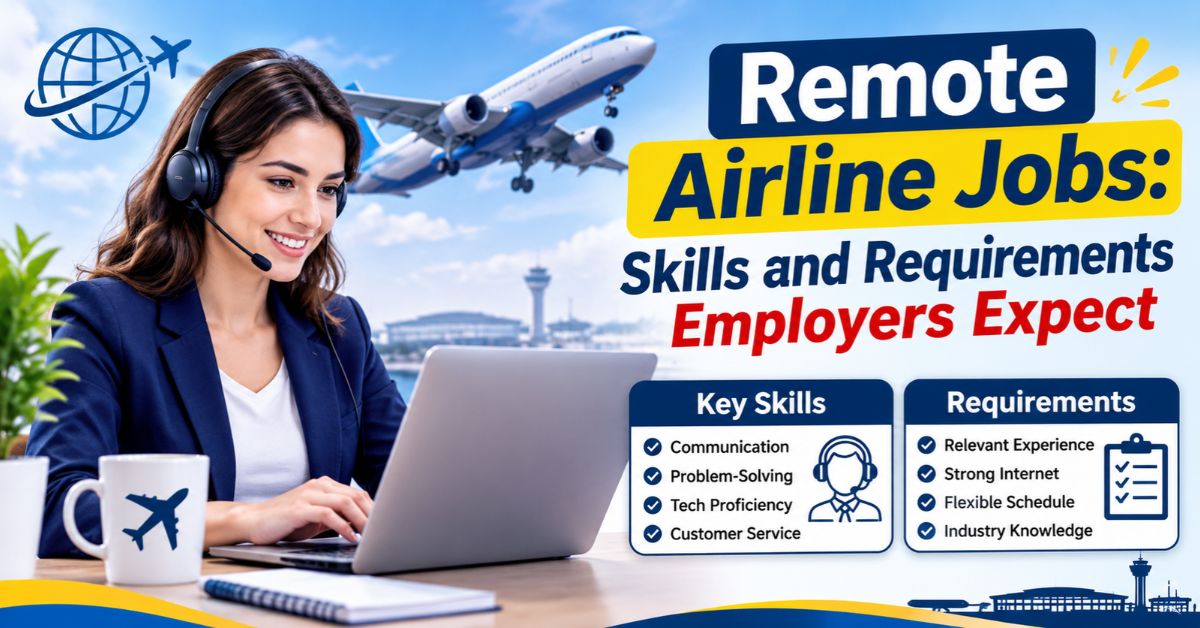
Employers want proven reliability more than fancy titles. For customer roles, expect to need strong English, a quiet workspace, a stable internet connection, and a reliable computer with a headset. Many postings request prior call-center or service experience. Familiarity with global distribution systems such as Sabre, Amadeus, or Travelport gives you an edge, and some employers train new hires on them.
Technical roles raise the bar. Data analysts should know SQL, Excel, and a visualization tool such as Tableau or Power BI. Developers need a portfolio and experience with cloud platforms. Cybersecurity candidates often hold certifications like Security+ or CISSP. Flight operations support favors people who understand scheduling, crew regulations, and aviation terminology. Whatever your track, show results with numbers, such as tickets resolved or errors reduced.
Quick readiness checklist:
- ☐ Quiet, dedicated workspace
- ☐ Stable internet and a working headset
- ☐ Résumé tailored to one track
- ☐ Proof of skills (portfolio, certifications, or metrics)
- ☐ Confirmed eligibility for the posting’s location
How to Apply for Remote Airline Jobs Step by Step
A clear process beats mass applications. Treat each application as a small project with a defined goal. Research the employer, match your experience to the posting, and submit only when you meet most requirements. Quality outperforms volume here because remote openings attract hundreds of applicants. Follow the steps below, and track every submission in a simple spreadsheet so you can follow up on time.
- Choose one career track that fits your skills.
- Add posting keywords to your résumé, such as reservations, loyalty programs, or data analytics.
- Confirm the residency requirement before you apply.
- Submit through the official career site or a verified board.
- Prepare for online assessments and video interviews.
- Follow up politely after one week.
Expect a multi-stage process. Many airlines run an online assessment, a recorded or live video interview, and a background check. Customer roles may include a typing or scenario test. Prepare short stories that show patience, accuracy, and problem-solving under pressure. After the interview, send a brief thank-you note within 24 hours. It keeps your name fresh and shows the professionalism airlines value.
Conclusion
Remote Airline Jobs are real, but they reward preparation. Choose a track that fits your skills, check residency rules first, and apply through verified sources. Customer care offers the easiest entry, while data and IT roles pay off with proven experience. If you live outside the U.S., target B2B travel partners and regional airlines. Stay patient, avoid scams, and keep building your aviation knowledge.
Finally, protect yourself while you search. Apply only through official career pages and verified boards, and never pay a fee to get hired. Keep a log of every application, follow up politely, and refine your résumé after each response. Persistence matters in a competitive field. With the right preparation, Remote Airline Jobs can become a rewarding way to build an aviation career without leaving home.